March 8, 2026
5 min
How to Avoid Style Conflicts in Micro-Frontend Architecture
Strategies to prevent global style leaks in distributed apps.
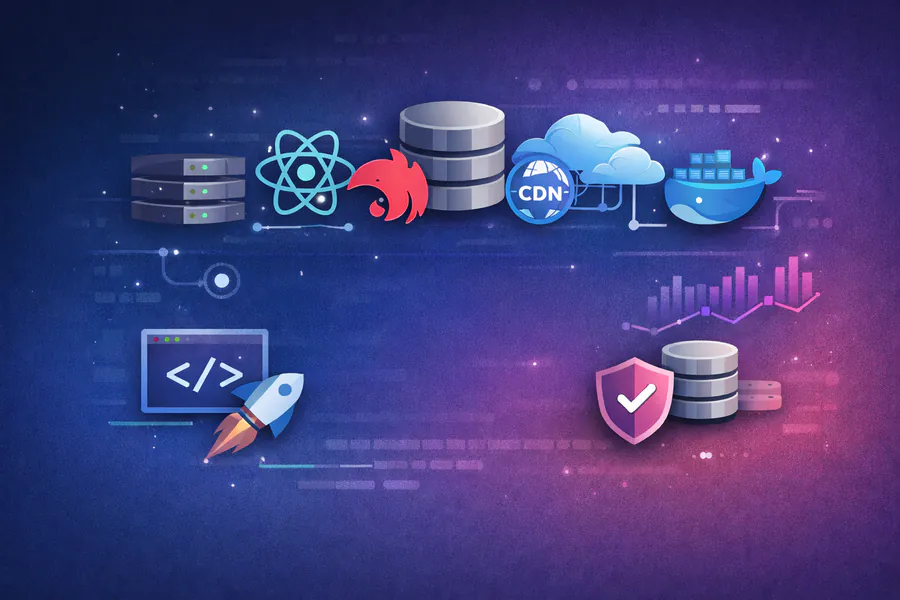
Over the years, I’ve tested dozens of tools, frameworks, and services. In 2026, my stack is not about “trendy technologies” — it’s a practical setup that helps me launch projects fast, scale them reliably, and avoid unnecessary complexity.
In this article, I’ll break down what I really use in production and why.
Next.js (App Router)
TypeScript
React Server Components
Tailwind CSS
shadcn/ui
Next.js combined with TypeScript provides:
Built-in SSR for SEO
High performance
Scalable architecture
Strong i18n support
Solid developer experience
App Router and RSC reduce client-side load and move more logic to the server.
Tailwind + shadcn help me build consistent UI fast without reinventing design systems.
NestJS
REST API
JWT (Access + Refresh)
Zod / class-validator
Swagger
In 2026, REST is still the most practical choice for most projects:
Easier caching
Simpler debugging
Better tooling
Lower complexity
NestJS gives me structure, dependency injection, and long-term maintainability.
JWT with refresh tokens provides secure stateless authentication.
Used for:
Blogs
Game and mod data
Multilingual content
Large datasets
Complex aggregations
Its schema flexibility and aggregation pipelines are ideal for content-heavy platforms.
Used for:
Payments
Subscriptions
Users
Billing
Financial records
Relational structure is essential for critical business data.
Cloudflare R2
Image Resizing
Workers
Why I use it:
No egress fees
Affordable storage
Built-in CDN
On-the-fly image optimization
For media-heavy platforms, this is a major advantage.
AWS EC2 / Lightsail
Docker
Docker Compose
Nginx
GitHub Actions
Automated deployments
Environment secrets
My goal: one-click deployment.
Commit → Build → Test → Production.
No manual steps.
Google Analytics 4
Google Search Console
Cloudflare Analytics
Ahrefs / Serpstat
SEO is part of system design, not an afterthought:
Server-side rendering
Schema.org markup
XML sitemaps
Clean URLs
Performance optimization
Lazy loading
Fast websites rank better.
Custom Tiptap editor
Markdown
A custom editor gives full control over:
HTML output
SEO structure
Media uploads
Localization
Cloudflare WAF
Rate limiting
reCAPTCHA
JWT rotation
CORS policies
Security is built in from day one.
VS Code
ESLint
Prettier
Commitlint
Postman
Automation beats discipline.
In 2026, I evaluate tools using five criteria:
Stability
Scalability
Control
Community
Cost
If a tool fails any of these, I don’t use it.
Frontend
Next.js + TypeScript + Tailwind + shadcn
Backend
NestJS + REST + JWT
Databases
MongoDB + PostgreSQL
Infrastructure
Docker + Nginx + AWS
Media
Cloudflare R2
SEO
SSR + Schema + GA4
My 2026 stack is not about hype.
It’s about:
Fast execution
Reliability
Ownership
Scalability
Profitability
I don’t chase trends. I build systems that last.
Let's discuss how I can help bring it to life. I'm happy to answer questions and suggest possible solutions.
Contact me