
March 4, 2026
2 min
When CSS Becomes a Performance Problem
How excessive selectors and deep nesting affect rendering performance.
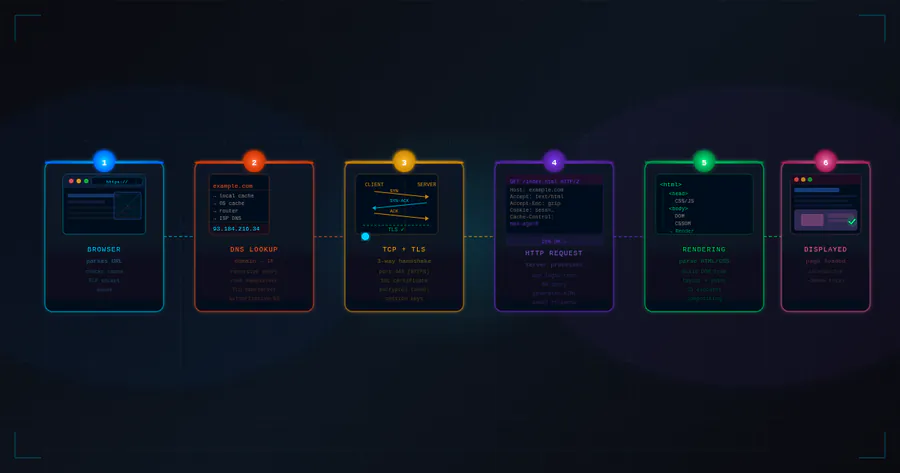
Pressing Enter after typing a web address in the browser’s address bar sets off a sophisticated sequence of events that spans your computer, local network, global infrastructure and finally a remote server. While it all feels instantaneous, dozens of discrete steps unfold under the hood.
https:// if omitted and converting punycode for internationalised domains.Human-readable domain names must map to numerical IP addresses before any connection can be made.
The final response contains one or more A (IPv4) or AAAA (IPv6) records representing the server’s address.
The client and server exchange SYN and ACK packets to create a reliable channel, negotiating window sizes and other transport parameters.
If encryption is required, an additional handshake negotiates protocol versions, cipher suites and shares public keys. Certificate validation assures the browser that the server is who it claims to be.
Only now does the browser transmit its first HTTP message, typically a GET / request containing:
The web server routes the request through layers such as load balancers, reverse proxies and application logic. Static files may be served directly, or dynamic pages generated through scripts, databases and microservices.
The server returns an HTTP response made of:
Compression (gzip, brotli) and chunked transfer encoding may be applied to optimise delivery.
As the HTML is parsed, external assets—CSS, JavaScript, images, fonts, media—are requested. Many run concurrently over the same TCP/TLS connection using HTTP/2 multiplexing, or via new connections if needed.
On a well-optimised site served from a nearby CDN node, the entire sequence—from keystroke to fully rendered page—can finish in under a second. Yet each millisecond is earned through layers of protocols, hardware and software working in concert.
Let's discuss how I can help bring it to life. I'm happy to answer questions and suggest possible solutions.
Contact meHow excessive selectors and deep nesting affect rendering performance.

Compares rendering strategies with real implementation examples, focusing on SEO impact, scalability, caching strategies, and infrastructure cost.