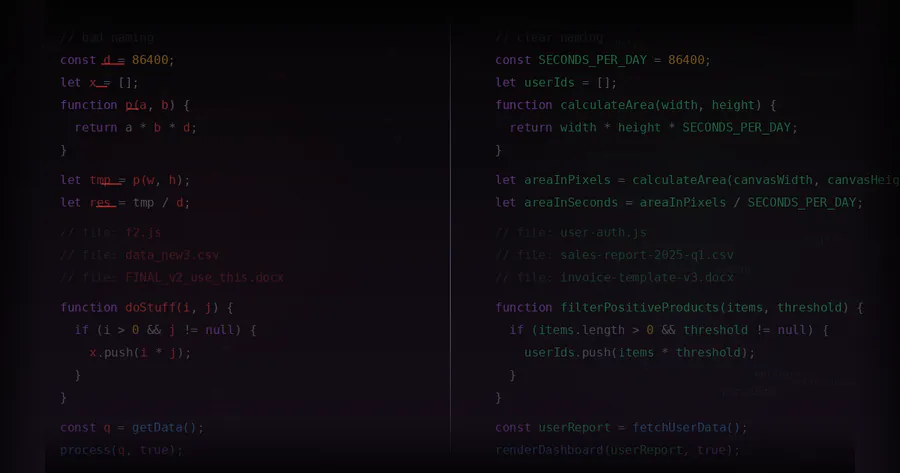
Why Naming Matters: How Good Variable and File Names Improve Understanding
Clear names in code and files are one of the simplest and most powerful tools for improving understanding. Good naming reduces cognitive load, speeds up onboarding, and makes it easier to change systems safely over time.
Names Are the First Layer of Documentation
Before anyone reads a comment, a design document, or a README, they see names: variable names, function names, class names, and file names. Those names form the first mental model of the system.
When names clearly express purpose, developers can often understand what is happening without diving into every implementation detail. This lets them focus on the behavior and design rather than deciphering intent.
Conversely, weak or misleading names force readers to constantly cross-check definitions. The more often they need to jump to the implementation to figure out what a name really means, the slower and riskier the work becomes.
The Cost of Poor Naming
Poor names carry hidden but significant costs over a project’s lifetime. Some of the most common problems include:
- Higher cognitive load: Short or vague names like
data,tmp, orresultforce readers to hold more context in their head to remember what each one represents. - More bugs: Misleading names, such as a variable called
isValidthat is actually false when valid, can create subtle logic errors that are hard to track down. - Slower reviews: Code review takes longer when reviewers must mentally translate each name back to its real meaning.
- Harder onboarding: New team members need much more time to build a mental model of the system if the naming is inconsistent or unclear.
- Fear of refactoring: When names don’t align with behavior, developers become nervous about changing code because they cannot trust what they are reading.
Good Variable Names Clarify Intent
Variables often carry business concepts, configuration values, or intermediate results. Good variable names make the developer’s intent explicit.
Effective variable names have a few consistent traits:
- They describe what, not how: A variable like
maxRetryAttemptsis clearer thann. It tells future readers what the value represents rather than how it is used. - They match the domain language: Using words from the problem domain, such as
invoiceTotalorshipmentStatus, helps non-technical stakeholders and new developers understand code more quickly. - They reflect units and types: Names like
timeoutMsorpriceCentsreduce confusion about how values are interpreted. - They respect scope: Shorter names like
iorxcan be acceptable in very small, obvious scopes (for example, a tiny loop). As scope grows, names should become more descriptive.
When variables are named well, reading code feels more like reading a series of statements in plain language. You can often guess behavior before looking at the implementation details.
File Names Shape How We Navigate Projects
File names determine how people find and group logic within a repository. Good file names reduce the time it takes to answer basic questions such as “Where is this feature implemented?” or “Where should I add this new behavior?”
Helpful file naming practices include:
- Align with features or responsibilities: Names like
user_authentication_serviceororder_summary_viewprovide direct hints about what the file contains. - Be consistent across the project: If one file is named
user_controller, avoid calling another similar fileaccountHandler. Consistency allows developers to predict names before searching. - Avoid generic containers: Files with names like
utilsormisctend to accumulate unrelated logic, making them harder to understand and maintain over time. - Mirror the architecture: If your system is organized by domain, layer, or bounded context, file names should reflect that structure so the directory tree itself tells a story.
When file names match architectural boundaries and business features, the project structure becomes a living map of the system.
Naming and Team Communication
Names also serve as shared communication tools within a team. Every time you choose a name, you are standardizing a piece of language the team will likely reuse in discussions, design documents, and commit messages.
Consistent naming supports:
- Clear conversations: When everyone uses the same words for the same concepts, discussions are more precise and less confusing.
- Aligned mental models: Names like
CartItem,Order, andShipmentcan correspond directly to diagrams and business processes, reducing the gap between code and reality. - Better collaboration across roles: Product managers, QA engineers, and designers can more easily understand and reference code when its naming aligns with product terminology.
Inconsistent naming, by contrast, breeds misunderstandings: two developers may use different names for the same concept, or the same name for different concepts, and end up talking past each other.
Guidelines for Choosing Better Names
Improving naming is mostly about slowing down just enough to be deliberate. Some practical guidelines include:
- Prefer clarity over brevity: Longer, precise names are usually better than short, ambiguous ones. The time saved reading clear code outweighs the extra keystrokes.
- Name by responsibility, not type: Instead of
userList, consideractiveUsersorpendingInvitedUsersto capture intent, not just structure. - Avoid noise words: Generic suffixes like
data,info, orobjectrarely add meaning. If you can remove a word without losing clarity, it is probably noise. - Use established patterns: Follow the idioms of your language and framework (for example,
Controller,Service,Repository) instead of inventing new terms. - Keep concepts consistent: If you call a concept
Customerin one place, do not call itClientsomewhere else unless there is a real distinction. - Refine names as understanding improves: It is normal to rename variables, functions, and files as you learn more about the problem. Renaming is a legitimate form of refactoring.
Balancing Detail and Simplicity
Not every name needs to be long or heavily descriptive. The key is choosing a level of detail proportional to the scope and importance of the concept.
- Small, local scopes: Temporary variables in a short, obvious loop can have brief names, as long as the loop’s purpose is clear.
- Public interfaces and core concepts: Classes, public methods, API endpoints, and significant configuration keys deserve extra care and clarity, because they are used widely and live for a long time.
- Cross-cutting concepts: Shared utilities, reusable modules, and common domain objects should be named so that they make sense across different contexts, not only where they were first created.
Good naming is context-sensitive: it adapts to how widely and how long a name will be used.
Making Naming a Team Habit
For naming to consistently improve understanding, it needs to be part of the team culture, not just an individual preference. Teams can encourage good naming by:
- Discussing names in code review: Treat unclear or inconsistent names as review topics, just like logic or performance.
- Documenting vocabulary: Maintain a short glossary of domain terms and preferred names for core concepts.
- Refactoring without fear: Normalize small renaming changes in pull requests, as long as they are well-scoped and clearly described.
- Leading by example: Senior engineers and maintainers can model careful naming and explain their choices in comments and reviews.
Over time, shared habits and standards reduce friction and make it easier for everyone to write understandable code.
Conclusion: Names Are a High-Impact Investment
Good variable and file names are not cosmetic details; they are core to the clarity and health of a codebase. Thoughtful naming turns code into a more accurate narrative of how the system works. It reduces errors, speeds up reviews, aids onboarding, and helps teams communicate more effectively.
Pausing to choose better names—and being willing to improve them over time—is one of the simplest, highest-impact practices developers can adopt. Naming matters because understanding is the foundation of all reliable software change.